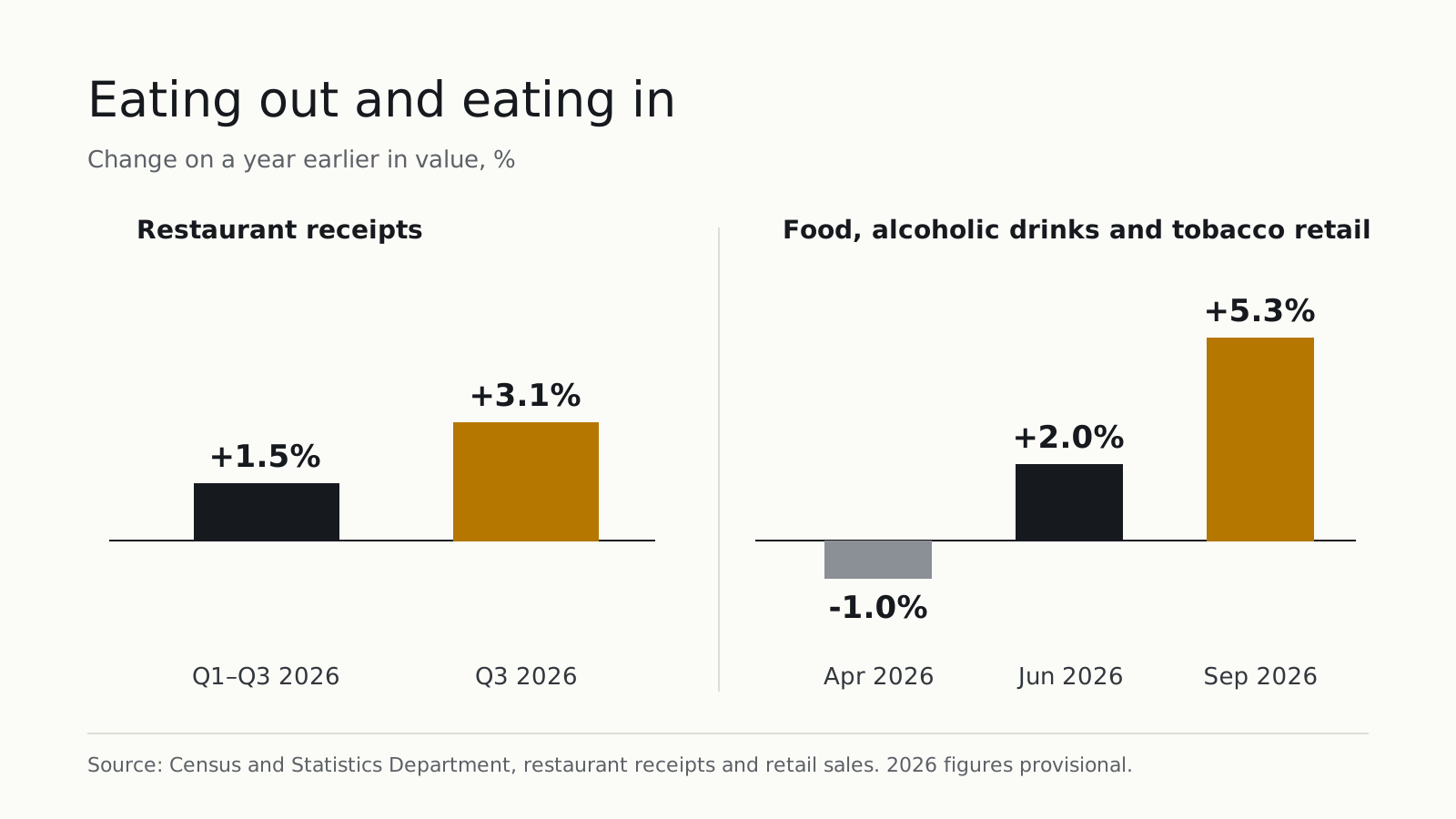
Hong Kong restaurant receipts rose 3.1% in value to HK$27.5 billion in the third quarter of 2026, but only 1.5% over the first three quarters. Food retail has turned faster: sales at food, alcoholic drink and tobacco outlets went from −1.0% in April to +5.3% in September 2026. The trend favours packaged food eaten at home, such as ready meals, hot pot bases and snacks.
Restaurants: steady, modest growth
The Census and Statistics Department publishes restaurant receipts every quarter.
| Period | Restaurant receipts | Change in value | Change in volume |
|---|---|---|---|
| Q3 2025 | HK$26.7 billion | — | — |
| Q3 2026 (provisional) | HK$27.5 billion | +3.1% | +2.1% |
| Q1–Q3 2026 | — | +1.5% | — |
Volume growth of 2.1% shows that more meals are being served, not only that prices are higher. But the pace is modest, and the first half of 2026 was weaker than the third quarter.
Food retail: a late but stronger turn
Food retail tells a different story. Sales at food, alcoholic drink and tobacco outlets fell in March (−0.4%) and April (−1.0%), recovered to +2.0% in June, and reached +5.3% in September 2026, helped by Mid-Autumn Festival purchases. Supermarkets, a separate category in the statistics, were still 1.0% lower in September.
Why the two move differently
- Prices. Underlying inflation was 2.1% in September 2026. A meal at home remains cheaper than a meal out, and households notice small differences when budgets are tight.
- Weekends across the border. Many residents eat out in Shenzhen at weekends, which takes spending away from Hong Kong restaurants more than from daily grocery shopping.
- Festivals. Food retail peaks around the Mid-Autumn Festival and Lunar New Year, when families buy gifts and eat together at home.
What it means for packaged food
When eating at home gains ground, three kinds of product benefit:
- Meals that replace a restaurant visit, such as instant river snail rice noodles or ready meals.
- Products that make a meal at home an occasion, such as hot pot soup bases and seasonings.
- Snacks for the evening at home, a category that NielsenIQ finds still growing in Hong Kong.
For a brand, that points to shelf positions in food supermarkets and snack specialists, clear cooking instructions on the Hong Kong label, and stock timed for festival weeks.
How to read these figures
Restaurant receipts are quarterly; retail sales are monthly. The figures are provisional and are revised in later releases. Compare value and volume where both are available, and do not add the two series together: they measure different businesses.
For the wider economy behind these numbers, see Hong Kong economy 2026.
Frequently asked questions
Are Hong Kong restaurants recovering in 2026?
Slowly. Receipts rose 3.1% in value and 2.1% in volume in the third quarter of 2026, but only 1.5% over the first three quarters.
Which packaged foods benefit when people eat at home?
Products that replace a restaurant meal or make a meal at home easier, such as instant and ready meals, hot pot soup bases and seasonings, and snacks eaten in front of the screen.
Sources
- Retail sales rise 6.4% in September as restaurants record modest quarterly gains · Dimsum Daily · 3 November 2026
- Provisional statistics of restaurant receipts and purchases for the third quarter of 2025 · Hong Kong Government · 4 November 2025
- Provisional statistics of restaurant receipts and purchases for the fourth quarter and whole year of 2025 · Hong Kong Government · 3 February 2026
- Hong Kong retail sales, monthly category changes · Trading Economics
- Retail sales for September 2026 · China Daily Hong Kong · 4 November 2026
- Hong Kong inflation, September 2026 · China Daily Hong Kong · 22 October 2026