
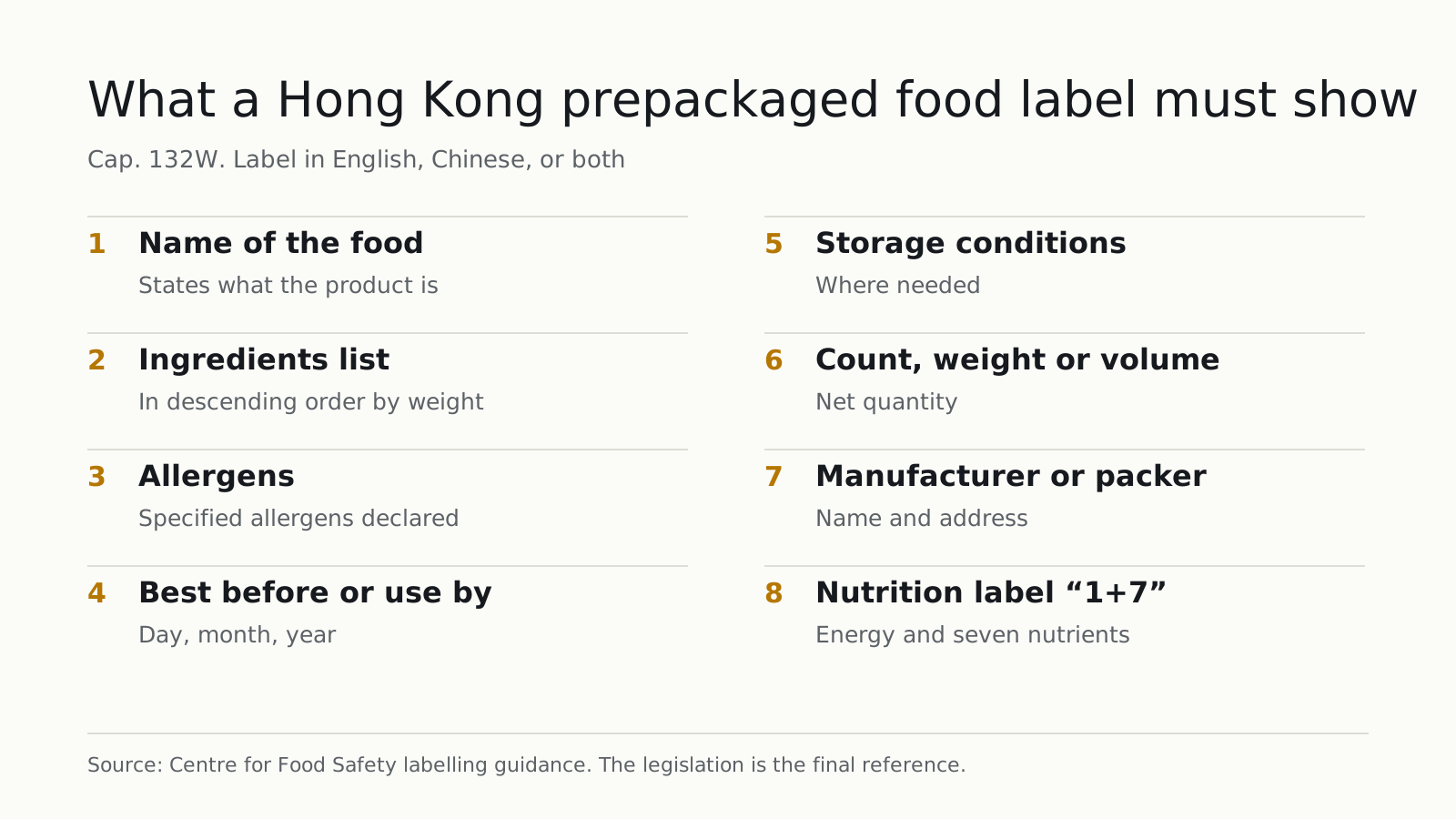
Prepackaged food sold in Hong Kong must carry a label that meets the Food and Drugs (Composition and Labelling) Regulations, Cap. 132W. The label can be in English, Chinese or both, and must show eight items, including a “1+7” nutrition table, declared allergens and a “best before” or “use by” date. Labels designed for Mainland China usually need a supplementary label before sale.
The eight items every label must carry
Cap. 132W sets out what a prepackaged food label must show. In the order the Centre for Food Safety lists them:
- Name of the food, which must not mislead about its nature.
- List of ingredients, in descending order of weight, headed “Ingredients” or “配料”.
- Allergens, declared in the ingredient list (see below).
- Shelf-life date: “best before” (此日期前最佳) or “use by” (此日期或之前食用), followed by the date.
- Special storage conditions or instructions for use, where they are needed to keep the food’s quality until that date.
- Count, net weight or net volume.
- Full name and full address of the manufacturer or packer, unless the Regulations allow otherwise.
- Nutrition label: energy and seven nutrients, known as “1+7”.
Each item has its own rules on wording and format. The four that cause most problems for imported products are the language, the nutrition table, the date and the allergen and additive declarations.
Language: English, Chinese or both
Schedule 3 of Cap. 132W allows a label in English, in Chinese, or in both. If both languages are used, the name of the food and the ingredient list must appear in both. Other languages are not accepted on their own, with a narrow exception for foods traditional to their country of manufacture. The Centre for Food Safety notes that Japanese kanji such as 原材料名 do not count as Chinese.
For Mainland brands, this means the Chinese text on the original pack can count towards the Hong Kong label. What usually needs adding is the content, not the language.
The nutrition label: “1+7”
Since 1 July 2010, prepackaged food in Hong Kong must declare energy plus protein, carbohydrates, total fat, saturated fat, trans fat, sodium and sugars, per 100 g or 100 mL, or per serving.
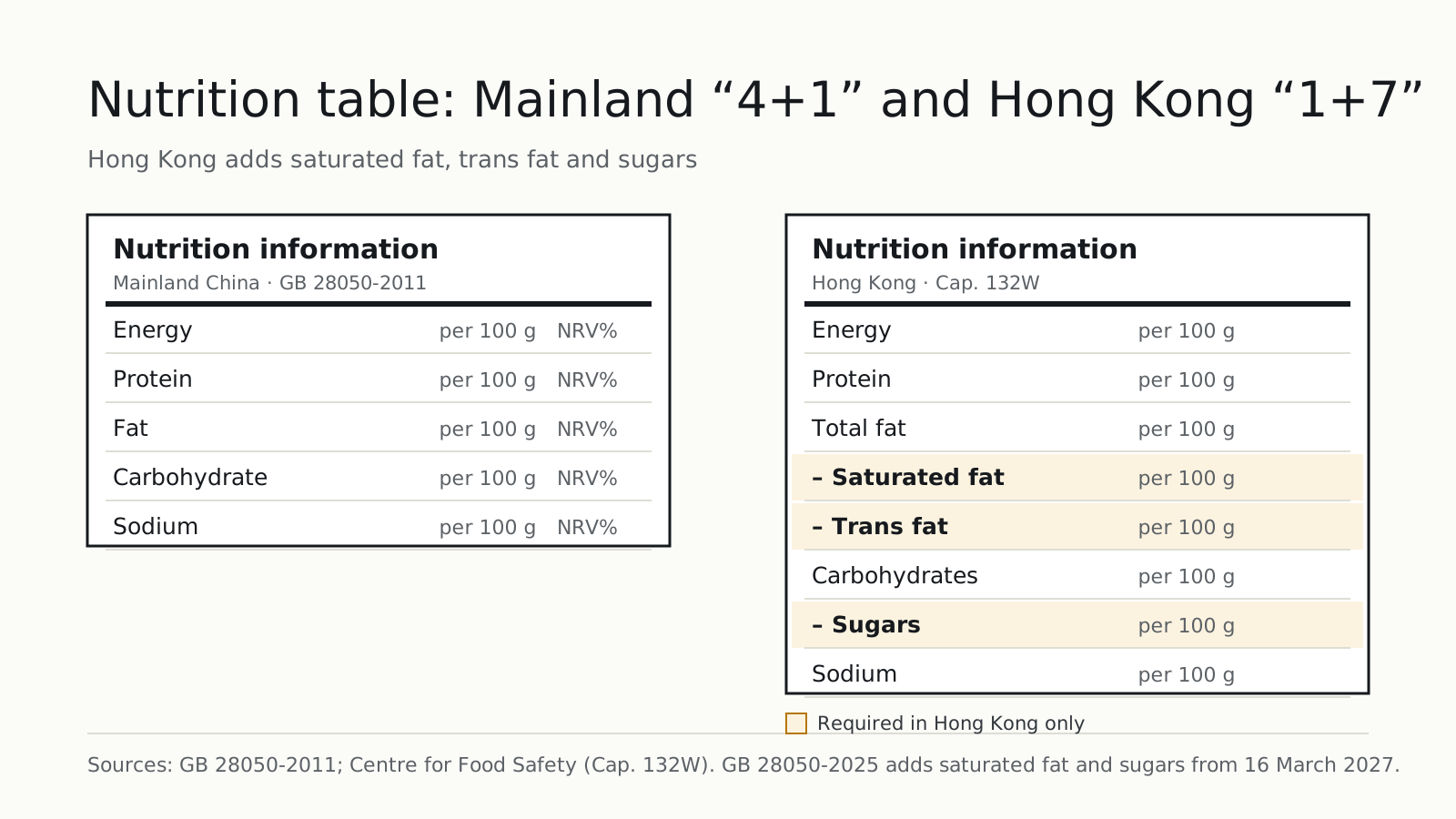
The Mainland standard GB 28050-2011 requires energy plus four nutrients (protein, fat, carbohydrate, sodium) with %NRV. Its replacement, GB 28050-2025, adds saturated fat and sugars from 16 March 2027, but trans fat remains a Hong Kong requirement that a Mainland table may not cover. A Mainland nutrition table on its own will therefore not meet Cap. 132W, today or after 2027.
Dates: “best before” and “use by”
A Hong Kong label shows a durability date, not a production date. The words must be “best before” and “此日期前最佳”, or “use by” and “此日期或之前食用”, followed by the date. The Centre for Food Safety’s guidance asks for the day, month and year to be marked in English and Chinese (日、月、年), and they may appear in any order.
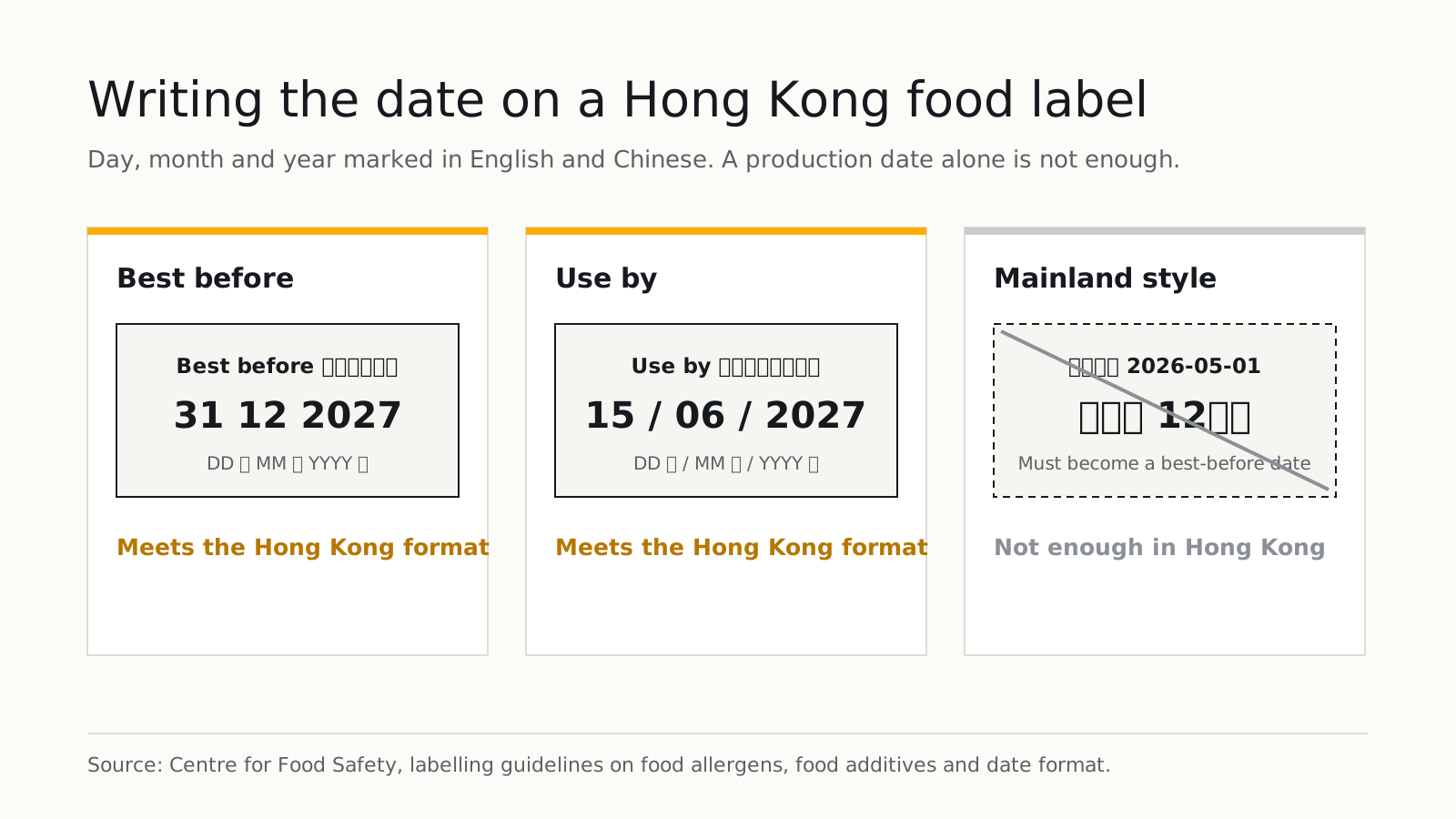
For the year in Chinese, “年” or “年(西元年)” is accepted; “西元年” on its own is not.
Allergens and additives
Since 10 July 2007, the following must be declared in the ingredient list when present:
| Allergen group | Notes |
|---|---|
| Cereals containing gluten | Wheat, rye, barley, oats, spelt and their products |
| Crustacea | And crustacean products |
| Eggs | And egg products |
| Fish | And fish products |
| Peanuts and soyabeans | And their products, including soy lecithin |
| Milk | And milk products, including lactose |
| Tree nuts | And nut products |
| Sulphite | When present at 10 parts per million or more |
Food additives are declared by functional class plus specific name or INS number, for example “Preservative (211)”. The guidance specifies the Chinese terms for each class; “酸味劑” is accepted, “酸” on its own is not.
Mainland labels often differ here. Allergen declaration is only recommended under GB 7718-2011 and becomes mandatory for eight groups under GB 7718-2025 from 16 March 2027. Mainland labels also name additives by their GB 2760 names without the functional class.
Mainland label and Hong Kong label compared
| Item | Mainland China | Hong Kong (Cap. 132W) |
|---|---|---|
| Language | Standard Chinese characters | English or Chinese, or both |
| Nutrition | Energy + 4 nutrients, %NRV | Energy + 7 nutrients |
| Date | Production date and shelf life | “Best before” or “use by” date |
| Allergens | Recommended (mandatory from March 2027) | Mandatory since 2007 |
| Additives | GB 2760 names | Functional class + name or INS number |
| Manufacturer | Producer or distributor details | Manufacturer or packer, full name and address |
Sticker labels
Where the original pack lacks an item, a supplementary sticker label is commonly added in Hong Kong. It must be legible, must not cover required information on the original pack, and must not give a false description of the food, which is an offence under section 61 of Cap. 132. The Centre for Food Safety expects written authorisation from the manufacturer before a sticker is used to correct allergen or additive details.
Small Volume Exemption
A product with annual Hong Kong sales of no more than 30,000 units, and with no nutrition claim on its label or in advertising, can be exempted from the nutrition labelling requirement. The importer applies to the Centre for Food Safety, and the exemption has to be renewed. It is revoked if sales exceed the limit. The other label items still apply.
A recent change: konjac jelly mini-cups
From 1 April 2026, Hong Kong prohibits mini-cup konjac jelly with a height or width of 45 mm or less, because of the choking risk. The maximum penalty is a fine of HK$50,000 and six months’ imprisonment. The rule concerns jelly in mini-cups; konjac snacks in strip form, such as Weilong’s Mo Yu Shuang, are a different format.
Registration and records
Labels are one half of the rules. Under the Food Safety Ordinance (Cap. 612), in force since 2011, businesses that import food or distribute it by wholesale must register with the Food and Environmental Hygiene Department. They must also record each consignment and keep the records for 3 months for food with a shelf life of 3 months or less, or 24 months for other food.
Checklist before the first shipment
- Compare the current pack, item by item, with the eight Cap. 132W requirements.
- Prepare the 1+7 nutrition values per 100 g or 100 mL from laboratory or formulation data.
- Add a best-before or use-by date in the Hong Kong form.
- Declare all eight allergen groups and rewrite additives as functional class plus name or INS number.
- Decide whether to print a Hong Kong pack or apply a sticker, and obtain the manufacturer’s authorisation where needed.
- Check whether the product qualifies for the Small Volume Exemption.
- Check formats against recent rules, such as the konjac jelly mini-cup ban.
Our page for brand owners lists the information we ask for, and the warehouse and delivery page explains how stock moves once it reaches Hong Kong.
Frequently asked questions
Can a product with a Mainland Chinese label be sold in Hong Kong without changes?
Only if the label already carries every item Cap. 132W requires. Most Mainland labels lack the full 1+7 nutrition table and a best-before or use-by date in the Hong Kong form, so a supplementary label is usually needed.
Does a Hong Kong food label need both English and Chinese?
No. Either language is enough. If the label uses both, the name of the food and the list of ingredients must appear in both languages.
What is the Small Volume Exemption?
A product sold in Hong Kong at no more than 30,000 units a year, with no nutrition claim on its label or in advertising, can be exempted from nutrition labelling. The importer applies to the Centre for Food Safety, and the exemption must be renewed.
Can a sticker be used to correct a label?
Supplementary sticker labels are commonly used, but they must not cover required information. The Centre for Food Safety expects written authorisation from the manufacturer before a sticker is used to correct allergen or additive details.
Sources
- Frequently asked questions on food labelling requirements for prepackaged food · Centre for Food Safety
- Labelling guidelines on food allergens, food additives and date format · Centre for Food Safety
- Food legislation · Centre for Food Safety
- Small Volume Exemption scheme · Centre for Food Safety
- Food and Drugs (Composition and Labelling) (Amendment) Regulation 2025 to take effect on April 1 next year · Centre for Food Safety · 21 August 2025
- Record-keeping requirement relating to food · Centre for Food Safety
- Food Safety Ordinance to come into effect tomorrow · Hong Kong Government · 31 July 2011
- GB 7718-2011 National food safety standard: General rules for the labelling of prepackaged foods (Chinese text) · FAO, FAOLEX
- National Food Safety Standard: General Rules for Labelling of Prepackaged Foods (GB 7718—2025) · FAO, FAOLEX
- National Food Safety Standard: General Rules for Nutrition Labelling of Prepackaged Foods (GB 28050—2025) · FAO, FAOLEX
- China published GB 7718-2025, GB 28050-2025 and food labeling measures · CIRS Group