
To get a packaged food product listed in Hong Kong retail, a brand needs a product sheet the buyer can decide on, a label that meets Cap. 132W, a GTIN barcode on every unit and carton, enough shelf life on arrival, a suggested retail price and a launch plan. A local distributor holding stock in Hong Kong makes small, frequent orders possible.
Where packaged food is sold in Hong Kong
Packaged food reaches Hong Kong shoppers through several kinds of shop, each with its own buying habits.
| Format | What it looks for | Examples among the retailers Hong Shine supplies |
|---|---|---|
| Supermarket | Steady sellers, full product data, reliable supply | 家興超級市場 |
| Food supermarket | Value, wide range, fast turnover | 友誠食品平價超市 |
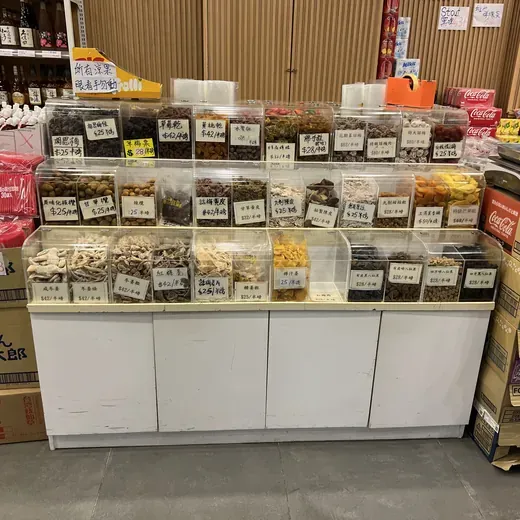
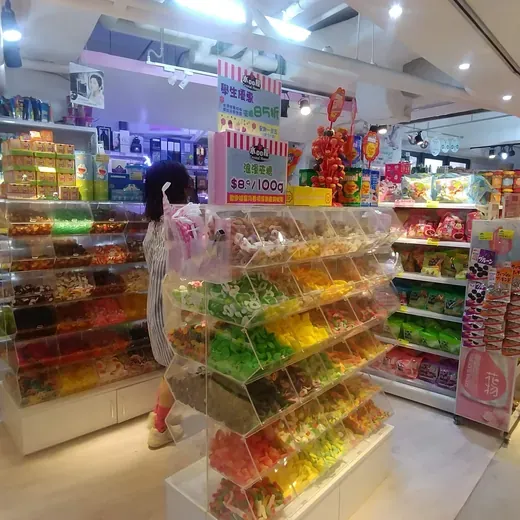
| Snack specialist | New products, frequent range changes, eye-catching packs | 零食皇 Snack Wong, 水晶屋 Crystal House |
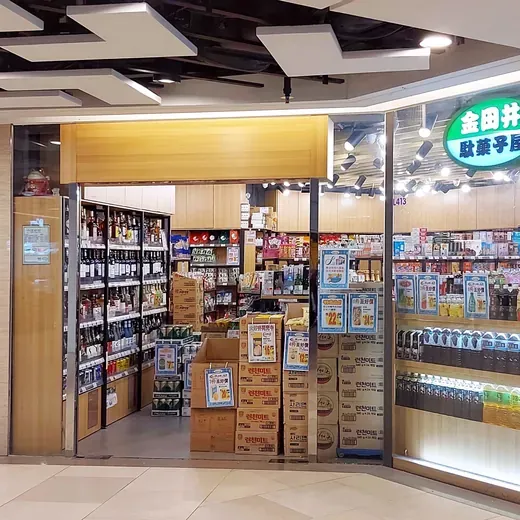
| Japanese-style snack shop | Imported snacks and sweets, gift packs | 金田井 |
| Online platforms | Good photographs and product data | 13.1% of all retail sales in September 2026 |
What a buyer asks for
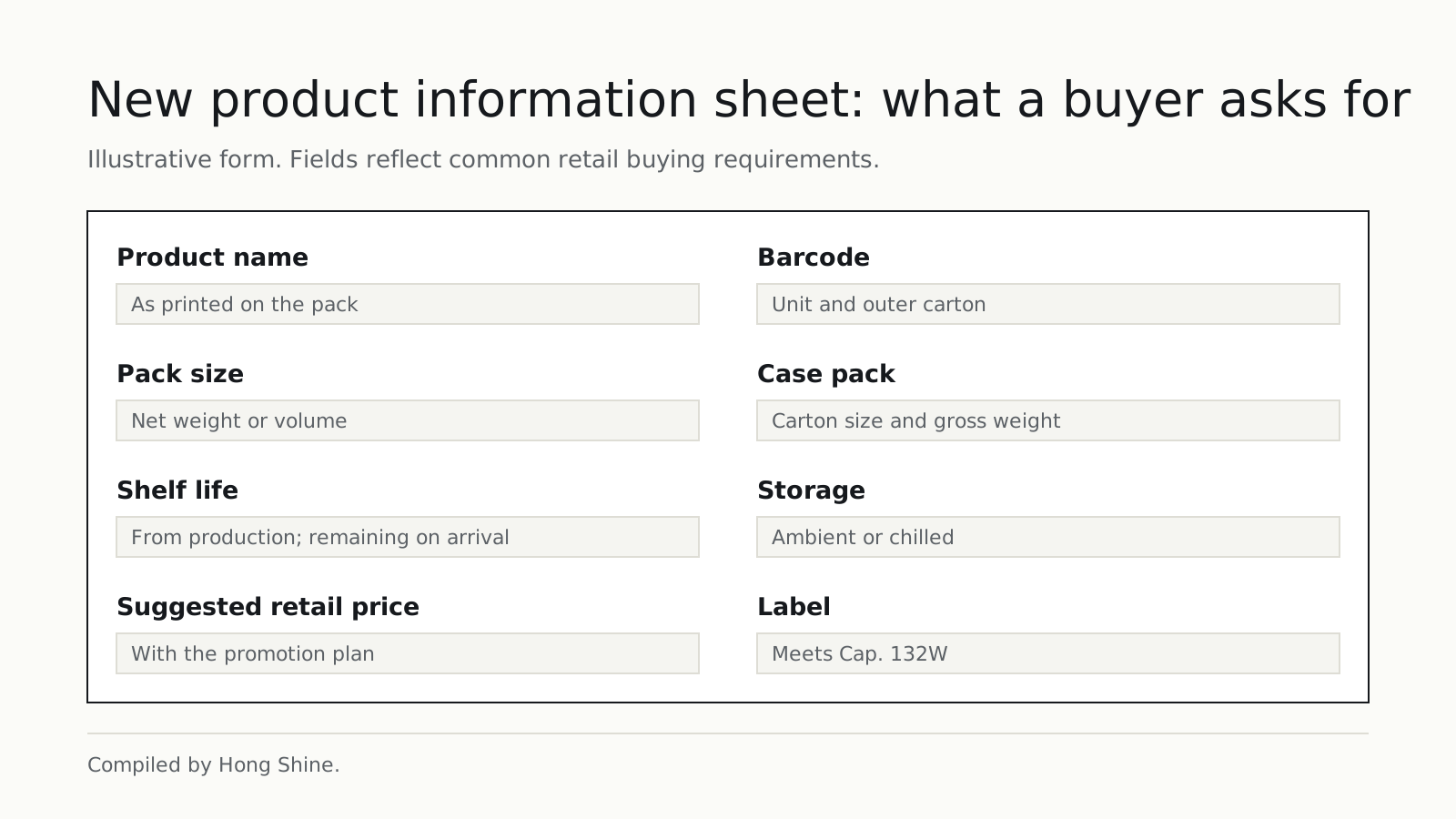
A buyer usually decides on one page. Prepare it before the first meeting:
- Product name in English and Chinese, exactly as on the pack.
- Barcode for the unit and the outer carton.
- Pack size (net weight or volume) and case pack: units per carton, carton size and gross weight.
- Shelf life from production, and the shelf life remaining when goods reach Hong Kong.
- Storage: ambient or chilled.
- Suggested retail price, and the promotion you plan to support.
- Label status: whether the pack already meets Cap. 132W or will carry a supplementary label.
- Photographs: front and back of pack, on a plain background, for the retailer’s systems and online listings.
The label must be ready
A retailer cannot sell prepackaged food that does not carry a Cap. 132W label, so label status often decides the conversation. The usual gaps on imported packs are the 1+7 nutrition table, a best-before date in the Hong Kong form, and allergen and additive declarations. Our labelling guide explains each one.
Barcodes
Hong Kong retailers scan GTIN barcodes (EAN-13 on most consumer units). Codes issued by GS1 China, with prefixes 690 to 699, are valid worldwide and scan in Hong Kong; GS1 Hong Kong issues codes with prefix 489. Give the outer carton its own code, so the warehouse and the store can receive it by scanning.
Shelf life on arrival
There is no single legal minimum. Each retailer sets its own acceptance level, and the distributor needs stock to move by expiry date, oldest first. Under the Food Safety Ordinance, importers and wholesalers also keep records for 3 months for food with a shelf life of 3 months or less, and 24 months for other food. State both the total shelf life and the remaining shelf life you can guarantee on arrival.
Price and launch plan
- Suggested retail price. Buyers compare it with similar products on their shelves and, increasingly, with prices shoppers see across the border.
- Launch support. Tasting, display or price promotions help a new product earn its space.
- Festival timing. Food sales rise around the Mid-Autumn Festival and Lunar New Year; aim for stock to arrive several weeks before.
- Online. With online sales at 13.1% of retail, product photographs and bilingual descriptions matter as much as the pack.
Working with a distributor
Most Hong Kong shops order small quantities often and expect delivery from local stock. A distributor that holds stock in Hong Kong, already supplies the retailers and keeps the records the law requires makes that possible. Hong Shine supplies supermarkets and snack specialists across Hong Kong from its warehouse in San Po Kong; see our distribution network and our page for brand owners.
Frequently asked questions
Do Mainland Chinese barcodes work in Hong Kong shops?
Yes. Barcodes issued by GS1 China (prefixes 690–699) are global GTINs and scan in Hong Kong. Each unit and each outer carton needs its own code.
How much shelf life does a Hong Kong retailer expect?
There is no single legal rule; each retailer sets its own acceptance level. Plan for shipping, warehousing and a full selling period, and state both the total shelf life and the remaining shelf life on arrival.
Can a product be listed before its Hong Kong label is ready?
No. Prepackaged food must carry a Cap. 132W label when it is sold. Prepare the label, or a supplementary sticker label, before the first delivery.
Sources
- Frequently asked questions on food labelling requirements for prepackaged food · Centre for Food Safety
- Record-keeping requirement relating to food · Centre for Food Safety
- GS1 Company Prefix · GS1
- Retail sales for September 2026 · China Daily Hong Kong · 4 November 2026
- Cross-border and overseas purchases are reshaping Hong Kong FMCG spending · NielsenIQ