
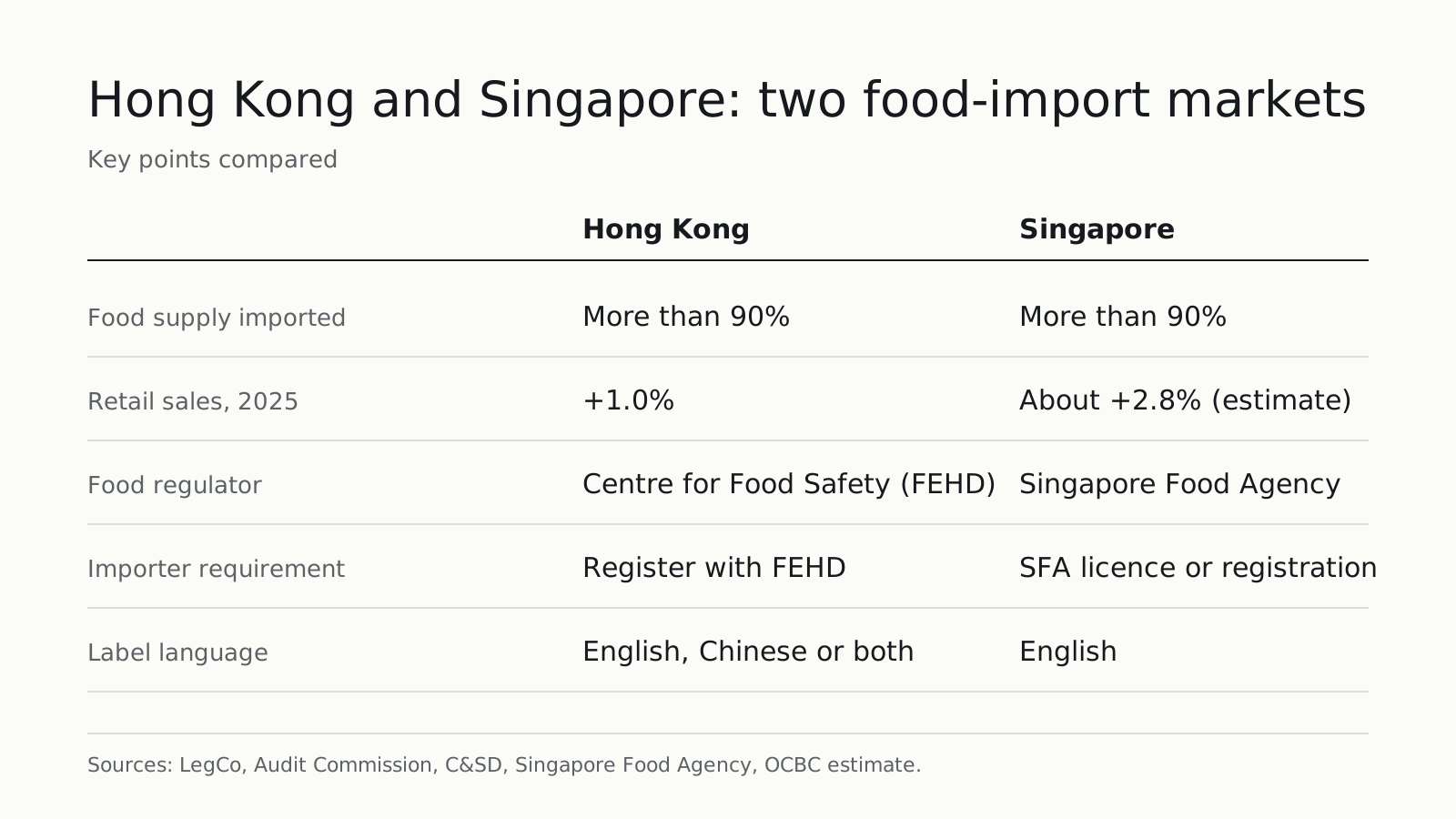
Hong Kong and Singapore both import more than 90% of their food, but their rules differ. Hong Kong accepts labels in English or Chinese and requires a “1+7” nutrition table; Singapore requires English labels, an SFA licence or registration and a permit for every consignment, and Nutri-Grade marks on some products. For Mainland Chinese brands, Hong Kong usually needs fewer changes to the pack.
The same starting point
Hong Kong relies on imports for more than 90% of its food, according to the Legislative Council Secretariat and the Audit Commission. Singapore also imports more than 90%, from more than 180 countries and territories, according to the Singapore Food Agency (SFA). In both cities, almost every packaged food on the shelf has been imported by someone.
Different rulebooks
| Topic | Hong Kong | Singapore |
|---|---|---|
| Food regulator | Centre for Food Safety (FEHD) | Singapore Food Agency |
| Importer requirement | Registration under the Food Safety Ordinance (Cap. 612), with records kept for 3 or 24 months | SFA licence or registration; an import permit for each consignment through TradeNet |
| Label language | English or Chinese, or both | English; an English sticker label is accepted if firmly attached and not covering mandatory information |
| Nutrition information | “1+7” table on prepackaged food, with exemptions such as the Small Volume Exemption | Not mandatory for all foods; Nutri-Grade for specified products |
| Front-of-pack grade | None | Nutri-Grade: mandatory for beverages graded C or D since 30 December 2022; extending to salt, sauces, seasonings, instant noodles and cooking oils from mid-2027 |
For a Mainland brand, the language rule is the biggest practical difference. A Chinese-language pack already meets Hong Kong’s language requirement; the work is to add the missing items. For Singapore, an English label is required, and products in the categories covered by Nutri-Grade need grading against its sugar, saturated fat and, from 2027, sodium thresholds.
Retail momentum
Hong Kong retail sales rose 1.0% in value in 2025, to HK$380.5 billion, and then grew for seventeen consecutive months to September 2026. OCBC estimates Singapore’s retail sales grew about 2.8% in 2025; this is a bank estimate, not an official full-year figure. The two cities are of similar scale but differ in what drives growth: in Hong Kong, visitor spending and cross-border travel play a large role.
What it means for brands choosing a first market
- Mainland brands with Chinese packs: Hong Kong is the shorter step. Add the 1+7 nutrition table, a best-before date and allergen declarations, often with a supplementary label.
- Beverages, sauces and instant noodles: check Nutri-Grade before choosing Singapore, especially for products high in sugar or sodium. Nutri-Grade’s 2027 extension covers instant noodles and sauces, which includes many Asian pantry products.
- Logistics: Hong Kong is a short trip from manufacturing regions in southern China, which keeps lead times and minimum orders small.
- Both markets expect a local importer or distributor who knows the rules and holds stock.
Our labelling guide explains each Hong Kong requirement in detail.
Frequently asked questions
Is Hong Kong or Singapore easier for a Mainland Chinese food brand?
On labels, Hong Kong is usually simpler: Chinese text counts, so the work is mostly adding the 1+7 nutrition table, a best-before date and allergen declarations. Singapore requires English on the label.
What is Nutri-Grade?
A Singapore front-of-pack grade from A to D. Since 30 December 2022, prepackaged beverages graded C or D must show it. From mid-2027 it extends to 23 sub-categories of salt, sauces, seasonings, instant noodles and cooking oils.
Sources
- Regulation of imported food in Hong Kong · Legislative Council Secretariat
- Food safety control of imported food (Report No. 71, Chapter 2) · Audit Commission
- Singapore Food Statistics 2024 · Singapore Food Agency
- What are the import requirements and legislation? · Singapore Food Agency, via Ask.gov.sg
- A guide to food labelling and advertisements · Singapore Food Agency
- Nutri-Grade requirements for key sources of sodium and saturated fat intake to take effect from mid-2027 · Ministry of Health, Singapore · 6 April 2025
- Measures for Nutri-Grade · Health Promotion Board, Singapore
- Frequently asked questions on food labelling requirements for prepackaged food · Centre for Food Safety
- December retail sales up 6.6%; 2025 retail sales value · news.gov.hk
- Singapore December retail sales · OCBC